.webp
)
.webp
)
.webp)
Phone editing used to be just cut the ends off a clip, put a washed out vintage filter and call it a day. If you wanted smooth motion or transitions hitting exact kick drums, you had to move your files to a PC.
That meant opening up Premiere or After Effects, sitting at a desk, and hours on a clip that should've taken twenty minutes. Then mobile editing apps blew up. Great for fast story posts, sure, but useless the second you want actual creative control—proper keyframing, clean masking, or custom curves.
Almost everything pushes preset templates. You tap a button, it spits out a generic look, and your video blends right in with every other reel. If you’re here, you’re probably sick of templates holding your hand.
Alight Motion 5.0.278 APK genuinely shifted what I thought a phone could do without overheating or crashing every five minutes. I’ve gone through dozens of mobile editors trying to build those snappy velocity edits you see across AMV and edit channels.
Most apps claim they can do it, but they lock everything behind paywalls or awkward interfaces that fall apart. Finding this specific release felt like having a stripped-down desktop compositing suite in my pocket. It bridges that frustrating gap between quick clipping tools and heavy PC suites.
Alight Motion 5.0.278 APK is still the build I tell people to track down if they do heavy gaming montages, typography, or anime edits. I don't point them to the newest store release because of stability. If you edit, you already know the sinking feeling of spending an hour dialing in color correction just for the app to choke and nuke your project file.
This build patched several memory leaks that used to trigger crashes when stacking effects like turbulent displace and directional blur. It runs noticeably cleaner on mid-range hardware and exports 4K without freezing up.
📌 What Is Alight Motion 5.0.278 APK?
For many mobile motion designers, Alight Motion 5.0.278 APK is a baseline standard. It’s basically a pocket-sized, layer-driven compositor. You can layer vector graphics, high-res photos and raw video tracks all on the same timeline. You're not just throwing text over a clip. You can draw shapes, connect elements, manipulate anchor points and build custom motion graphics from scratch.
It is easy if you have not sideloaded before, but Alight Motion 5.0.278 APK needs a quick download. Android Package Kit is the full form of APK. App stores frequently push updates that break favorite plugins or quietly tweak UI elements.
Grabbing this direct file keeps you on a reliable build that the community has already run into the ground with tests, instead of hoping the newest auto-update doesn't break your project workflow.
XML preset handling on this build is also remarkably solid. That matters if you trade project setups online. The XML format is basically the raw text data of your timeline. If I build a custom 3D bounce or shake, I export an XML file, send it over, and you drop it straight onto your own assets. Older builds threw errors on larger project files, but this version reads them cleanly.
🎮 How Does It Work?
The interface feels confusing on first launch if you’re coming from single-track timeline apps like CapCut. Everything works on vertical stacking. You start with an empty canvas. Tap the plus icon, add a clip, and that becomes layer one at the bottom. Drop your text above it, and that’s layer two. Whatever sits higher on the stack visually covers what’s below, identical to After Effects or Photoshop.
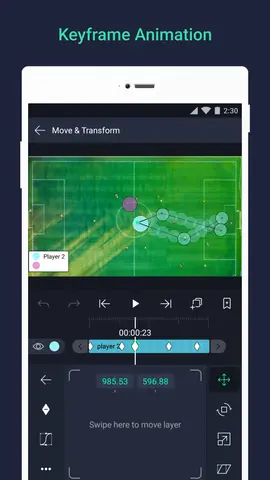
The diamond icon on the side is where actual editing happens—that’s your keyframe button. To slide text across the frame, you don't pick a canned transition. You go to your start point, tap the diamond to plant a keyframe, and drag the text off-screen. Move down the timeline a second, hit the diamond again, and drag the text to the center. The timeline engine figures out the motion in between.
Leaving it as a straight linear slide makes the movement feel stiff and mechanical, though. That’s why you tap the graph icon right below the keyframe tool. Drag the Bezier handles into an aggressive curve, and suddenly that stiff slide snaps into the screen fast, eases out, and lands smoothly.
You use the same keyframe-plus-curve routine on rotation, blur strength, scale, opacity and color values. It takes some practice to get the muscle memory, but once the timeline logic clicks, you can build just about any movement you want.
✨ Key Features Of Alight Motion 5.0.278 APK
🎥 Multiple Layer Support.
Most phone editors start choking the second you throw more than three tracks on screen. With this, you can just keep stacking stuff—raw footage, vector paths, sound effects, adjustment layers, whatever you need.
On busy intro projects I regularly pass 15 or 20 tracks, and when the screen gets too crowded to tap anything properly, I just bundle the finished parts into a single group. Keeps your head from spinning.
🎨 Vector and Bitmap Editing.
You almost never see an actual working pen tool on Android apps. You can tap to place points, pull out bezier handles, and draw shapes straight with your finger. Since it treats them as vectors instead of raster pixels, blowing a shape up 400% won't give you crunchy, blurred edges. I end up using this all the time to trace character outlines and animate the stroke path so lines sketch themselves in.
🎞️ Advanced Keyframe Animation.
Keyframes aren't just stuck to sliding position coordinates left and right. Almost every slider has that little diamond icon—blur intensity, color hue shifts, drop shadow angles, glow radius. When you hook those points up to the speed graph tool, you decide the exact snap and deceleration of every single movement.
🌪️ 160+ Visual Effects.
It feels much closer to desktop software than standard filter apps. You get stuff like turbulent displace, directional blurs, actual working chroma key that cleans up green fringes, and lift/gamma/gain color wheels. Throwing two or three light effects together usually gives you something that looks ten times better than the default presets everyone else uses.
💨 Velocity-Based Motion Blur.
Turn this on if you want fast animations to stop looking choppy. Whenever text or clips fly across the screen, it reads how fast the layer is travelling and smears the edges like a real shutter would. Set the blur strength around 1.2 or 1.4—pushing it all the way up just turns your clip into mush.
📂 Easy Preset Sharing (XML).
You can pack up an entire project or just an effect stack into a tiny XML file and share it around. You see these shared constantly across Telegram channels and YouTube descriptions. If someone figured out a crazy camera shake or velocity curve, you just grab their file, import it, replace the placeholder footage with yours, and the heavy lifting is already done.
📐 Linking and Parenting.
Saves you from doing the same thing four times over. Say you built a title card with two lines of text over a background box. You don't want to keyframe all three elements individually. Set the main box as the parent, link both text layers to it, and move only the box. The text follows along perfectly without losing its alignment.
💡 Benefits of Using Alight Motion 5.0.278 APK
Quick edits, no PC needed. I got tired of sending clips from my phone to my laptop, waiting for Premiere to load up, sitting at a desk just to make a 15 second reel. Real motion graphics on the train, killing time between classes, makes workflow way faster.
The graph editor is where the real value is. Basic editors lock you to a straight linear pace, which makes everything feel robotic. If a zoom doesn't land right on the beat drop of your audio, the whole video feels off. Being able to drag graph handles lets you make things snap right when the beat hits and glide smoothly afterward.
Big XML files load without crashing the app now. In older versions, importing a heavy project loaded with null objects and color grades would freeze your screen and kick you out to the launcher. Build 5.0.278 seems to manage RAM way better when handling those heavy community project files.
Everything you pick up here applies directly to After Effects later on. It is the same exact logic – layer parenting, speed curves, masking, blend modes, null layers. If you ever switch to editing on a computer, you won't be starting from scratch, because your brain already knows how compositing timelines work.
🛠️ Tips to Get the Most Out of It
📌 Master the Easing Graph.
Never leave keyframes on the default straight line. Linear motion looks cheap and flat. Take ten seconds to open the curve editor and pull the handles into an 'S' shape. That smooth ease-in and snappy ease-out is basically what gives motion edits that punchy look.
📁 Organize Your Layers.
Once you hit double-digit tracks, things turn into a mess fast. Rename your important layers so you know what is what and hide finished tracks with the eye toggle on the left side. It stops you from accidentally grabbing an old layer when you just want to grab a text box.
⚡ Utilize XML Presets.
Don't waste three hours trying to rebuild complex camera shakes from scratch if you're in a rush. Download an XML pack, open it up, and look at how they set the graph curves and keyframe distances. Breaking down other people's project files is honestly how most people figure out the app anyway.
🔋 Optimize for Performance.
Piling multiple blur and distortion effects on 4K clips is going to heat up your phone and drop frames in the preview window. While editing, lower the project preview to 360p or 540p in the settings. The screen might look a little soft, but playback won’t stutter, and your final export will still come out at crispy 1080p or 4K.
🎨 Try out Blending Modes
If you want to add film grain, dust scratches, or light leak overlays, don’t just play with the opacity slider. Drop the overlay into the top track and change the blending mode to Screen or Linear Dodge (Add). It cuts out all the black background instantly and blends the light smoothly over your footage.
📥 How to Download and Install Alight Motion 5.0.278 APK Latest Version
The most reliable and safe place to download from I recommend APKview.com as your resource. Random download sites don’t have that security layer of checking APK signatures before publishing.
Step 1: Open the browser on your Android device and go to APKview.com.
Step 2: Type “Alight Motion 5.0.278 APK” in the search box.
Step 3: Find the Latest Version of APK file Available Make sure it is from a trusted source on the site.
Step 4: Choose the download button. Your device might prompt you to confirm if you want to download the file – confirm if you want to download it.
Step 5: This is where most people get it wrong. You must allow installations from Unknown Sources. On most Android phones, go to Settings > Security > Unknown Sources and toggle it on. Some new phones may ask you to give permission for your browser only – just do what it tells you on your screen.
Step 6: Tap the downloaded APK file. It’s usually sitting in your Downloads folder.
Step 7: Click on Install and wait for few seconds. It's fairly fast.
Step 8: When done, open the app and sign up or login, if you have an existing account.
Just a Note : If you get an error, then the file is probably corrupted or you downloaded the wrong version. Download it again or check your Android version to see if it is supported.
🔒 Is It Safe to Use? Here's the Honest Take
Alight Motion 5.0.278 APK is totally fine to install, provided you aren't grabbing random files from sketchy corners of the web. The base app comes from Alight Creative Inc., a legit developer team.
Millions of mobile editors run it daily without issues, and it isn't snooping on your data behind your back. The permissions it asks for—storage to save your exports and mic access for quick voiceovers—are standard stuff for any actual editing tool.
The real trouble starts when people go chasing modified 'unlocked premium' files across sketchy Telegram channels or weird YouTube video descriptions. Half those cracked builds are packed with adware, battery-killing junk, or background trackers that cause real headaches.
That’s why you should only grab untouched packages from reliable mirrors like APKview.com that verify checksums against official builds. Stick to clean sources, ignore the tacky flashing "Download Here" banner ads, and you won't run into problems.
⚖️ Pros and Cons — The Unfiltered Take
✅ Pros:
- Real-deal keyframing and velocity curves directly on a phone screen.
- Proper vector path drawing and point editing, which almost no other Android video tool supports.
- Quick XML project sharing so you can swap entire transition setups with other creators in seconds.
- Pro-grade blending modes, luminance masks, and adjustment layers that feel straight out of desktop software.
- Clean layer grouping that saves your project timeline from turning into total visual chaos.
- Crisp rendering output that actually pushes full 60fps bitrates when your chipset has enough muscle.
❌ Cons:
- Stacking thirty layers on a compact phone display gets cramped fast.
- Throwing heavy displacement maps and motion blur onto an older phone will make it stutter and get warm.
- Definitely not a beginner app; the graph editor and coordinate systems take days of trial to grasp.
- Free exports stick a stubborn watermark in the corner unless you pay up.
- Live audio preview can drift by a few frames if you edit using cheap wireless earbuds with high latency.
🏁 Final Verdict — Is It Worth Downloading?
Alight Motion 5.0.278 APK earns its storage space if you actually care about motion design, keyframe control, or snappy beat-synced edits. If someone just wants to trim a family holiday clip or slap a vintage grain over their dog, this is complete overkill—CapCut or basic social editors handle that in two taps. But when you see those hyper-clean velocity edits, 3D text zooms, or custom null-object transitions on TikTok and Reels, this is usually what built them.
Alight Motion 5.0.278 APK will probably frustrate you on day one. Your first custom curve will look stiff, the anchor points might feel clunky, and nesting groups takes a minute to get used to. Once the workflow clicks, though, standard drag-and-drop timeline apps just feel painfully limited.
Grab a clean build, load an XML preset from YouTube to reverse-engineer how the timing works, and mess around on an empty canvas. It’s wild how close you can get to After Effects with just your phone.